Author Archive
Upcoming Blogposts February 2010
Just a quick post today to let you know what you can expect in the next few weeks. I am very excited about these upcoming posts, as I have only seen some concept versions – and yeah – they did look very promising!
Pamela Smith is writing on an article about power. She is a powerful woman and it’s also her topic of expertise. Thanks Pam – I am really looking forward to reading your article!
Sanne Nauts just called me about an article we have written together (ready to be published – yeah!). But that’s not what you are gonna get to read (however thinking about it…that might also be interesting) – she really knows all about the backlash effect and what women on a job interview should and should not do.
Fred Hasselman is my personal hero of Nonlinear time series analysis & Dynamical modeling. Don’t worry – he says he has come up with an ingenious way to communicate these topics to people with an IQ lower than 150 (world première!).
Hubert de Mey did give the best lecture I have ever had the opportunity to listen to (about why Skinner got it right and Chomsky got it wrong – such a pitty that battle was lost a few decades ago). He is going to write about why it is really really important to have a theory when doing research (and why mapping brain regions to “something” – does not make sense).
I have also been talking to Daniel Fitzgerald about a possible contribution to this blog. I can tell you more about it in a couple of weeks, but it will most probably be a series of short video interviews on fMRI research and technology.
I am really excited that this blog is growing and attracting such high quality writers. However if you are reading this and you are a student (=like me) I would like to tell you this: Don’t be scared – we’re all a big family. Your contribution is just as valuable – so keep it coming!
Your pretty excited
Martin Metzmacher
New Authors – Welcome!
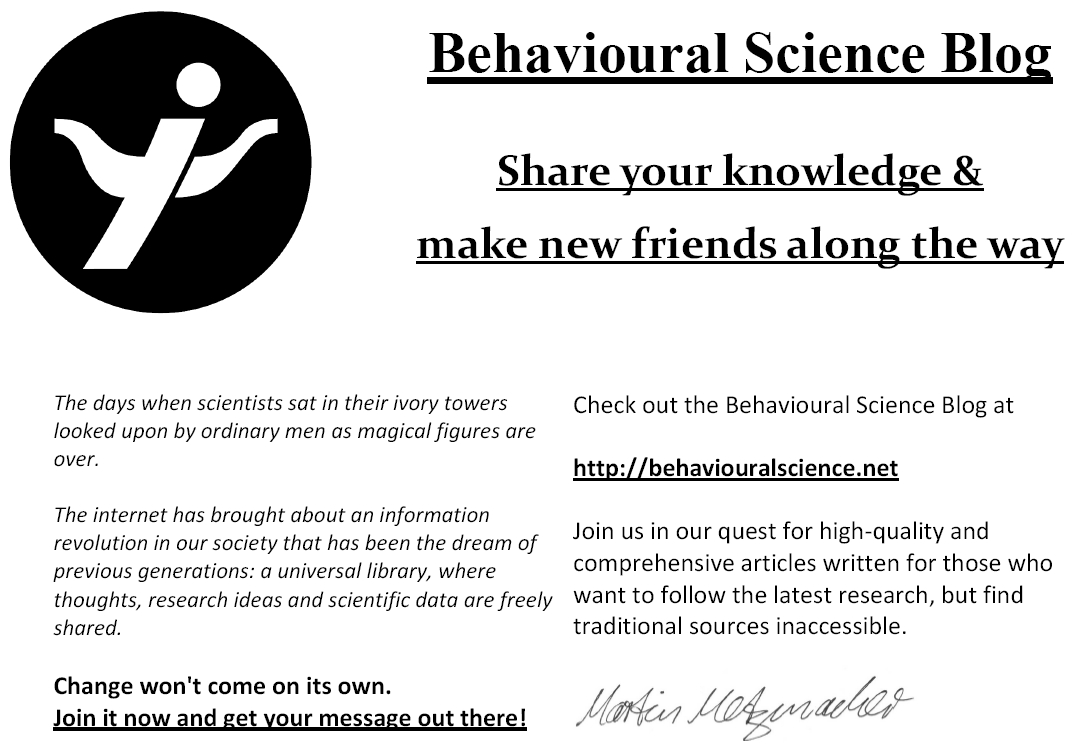 If you have been at the Radboud University in Nijmegen lately – you might have seen this ad (PDF). The Behavioural Science Blog is looking for new authors. Lots of them!
Writing this blog (together with Christina now for some times) has been one of the most interesting and also rewarding steps I have taken in my academical carrier.
Behavioural Science is often characterized by ground breaking, but very low-level research. Oftentimes it is only a very select group that actually read the article and often projects get abandoned, because the end goal “scientific article” is so far away.
I also wonder sometimes why we, as scientists, still use this very complicated system of scientific journals. Okay let’s be honest. Peer reviewed journals are very important when it comes to select high quality research – that’s for sure. But what is with all those really good, but not perferct research? And what is about those great ideas that you have, but never act upon?
As we enter the digital age this will all change – communication will be open, instead of closed. Ideas will spread fast, instead of slow and (from my perspective the best improvement) “ordinary” people will have access to scientific data and ideas.
However the language suited for writing for a select group of knowledgable people is different from the style when writing for “normal” people. It’s all about “What does that tell us?”, “WOW” and “Oh yes…I can use this piece of information for doing X!”.
This is what the Behavioural Science Blog is all about – and I think Dan said it best (so I put it in the ad):
Join us in our quest for high-quality and comprehensive articles written for those who want to follow the latest research, but find traditional sources inaccessible.
Change won’t come on its own.
Join it now and get your message out there!
If you want to become a part of this blog just send me an email and tell me a little bit about who you are and what you would like to write about. Videos, pictures, articles – it’s all welcome. The only thing I ask from you is that it comes in a format that makes it comprehensive to a large group of people, not only scientists in the field of behavioural science.
This has been a great journey for me and I enjoyed every bit of it. I hope you will enjoy it, too!

Martin Metzmacher
Research on classification and case formulation
It has been postulated (for example see Persons & Miakami) that psycho diagnostic evaluation is an important phase in the treatment of psychopathology. However there is a fierce battle going on between those that argue for a stepped-care model in mental health care and those that argue that we should rather look at the specific needs of an individual (matched care – could not find a suitable link -why?).
Connected to that is the question of how much information about the client you need in order to start treatment and if there is an amount of client information that is enough (that does not enhance the quality of the treatment plan any more).
If you can suffice with the DSM or ICD classification for treatment planning – why should you waste time on making an elaborate functional analysis of the client’s problems? However research (Persons & Miakami) has shown that treatment is not successful in about 40% of the cases and can be improved if diagnosticians make a functional analysis. This can sometimes help to focus treatment on the most important factor that keeps the client from getting healthy.
On the other hand Garb (1998 – it’s a book – for an overview read his 2004 paper: Clinical Judgment and Decision Making) has reported that lively details can influence clinicians to the degree that they make a wrong judgment about treatment decisions.
Thus we would like to know how much information should a therapist have in order to make a good treatment planning? Below I give you are plan for study 1 (total of 5 studies) with which we would like to start-up this line of research. It’s still in the planning phase and things have been changed around a lot, but we have found the direction I guess. I would like to ask you some feedback on this research.
Do you think this study answers the research question?
What do you think is the minimum amount of information that still feels “natural”?
What kind of disorders and empirically supported treatments (EST) would you chose?
What do we need to take care of when writing the vignettes?
Thanks a lot for your feedback. This is an experiment in itself: Can the global community of researchers and therapist help on improving this research idea? Can we work together – even though we will never meet? Or will someone steal this idea and conduct the research themselves? I am very thankful for your critical comments!
—–
Research Proposal Study 1
Study 1 addresses the question whether increasing amounts of diagnostic information, from classification only to classification plus extensive case formulation, changes clinicians’ treatment plans. On the basis of the literature and in line with national and international treatment guidelines, three frequently occurring DSM-IV Axis-I (clinical syndromes) disorders are selected for which familiar first-choice psychological ESTs are available. Using real patient files as a starting point, clinical vignettes are constructed, each one presenting a patient suffering from one of the selected DSM-IV disorders. These three vignettes are rewritten in such a way as to generate three Diagnostic Classification (DC) versions: DC, DC+, and DC++. Starting with the most complete DC++ versions, increasingly information is deleted to come to the DC+ and the DC versions. DC vignettes comprise 5-8 lines. From the DC++ versions information is removed, save: 1. demographic information (e.g., sex, age, marital status, children, current job), 2. treatment history (in all vignettes: ‘moderately successful pharmacological treatment only’), 3. current complete DSM-IV diagnosis, and 4. a recommended EST. DC+ vignettes are twice as long as DC vignettes and comprise 10-16 lines. They contain all the information that is available in DC vignettes, plus further anamnestic and psychodiagnostic information (e.g., family background, life history, personality). On the other hand, all lively details in the DC++ versions have been removed, in line with findings of Garb (1998) that clinicians are biased towards lively details in patients’ life histories. DC++ vignettes comprise 20-32 lines. They contain lively details originating from the patient files of real patients that are used as a starting point. The vignettes are piloted and tested for their ecological validity (cf. De Kwaadsteniet, Krol, & Witteman, 2008; Hutschemaekers, Tiemens, & Kaasenbrood, 2005; Witteman & Koele, 1999).
By contacting mental health institutes, 90 psychologists or psychiatrists are sought who have been involved in the intake and diagnosis of outpatients at least once a week for at least five years, and who are willing to participate in a study on diagnostic decision-making carried out by email. Each participant receives 3 vignettes. The participants are told that these three diagnostic reports were made by experienced clinicians of a large mental health institute. The participants are asked per vignette to address the following three issues: 1. What do you think of the recommended psychological treatment?, 2. Do you have recommendations for additional treatment or interventions?, and 3. Do you want to add contra-indications for certain interventions? Using a Latin Square Design for the selection of vignettes, it is ensured that for each participant all three patients and each of the three versions (DC, DC+ or DC++) are represented, and that all combinations (patients x versions) occur equally as often. For each of the three patient vignettes 30 DC, 30 DC+, and 30 DC++ versions are available. Power tables show that with alphas set at .05 and n = 30 in each cell, moderate to large effects can be identified with a power of .80 (Garssen & Hornsveld, 1992). When comparing the vignette versions without further regard to the patients, there are 90 versions in each cell, enough power to detect small effects.
We expect that the more diagnostic information is left out of the vignettes, the lower the variability in treatment suggestions of the participants. The hypotheses are that the evaluations of DC++ versions compared to evaluations of DC+ and DC versions, and evaluations of DC+ versions compared to DC versions show: 1. more deviations from recommended, first choice EST, and 2. larger numbers of indicated and contra-indicated treatment suggestions.
—–
Please give us some feedback – we are also thankful for questions and remarks about what is clear/not clear and about what you like/dislike! Also you might want to suggest a flash title for our research!

 Behavioural Science Blog